


Matchington Mansion
Magic Tavern, Inc.
I keep coming back to Matchington Mansion for the same reason I open a crossword or a quick card game: it gives me something understandable to do almost immediately. The basic idea is a puzzle game wrapped around home renovation, so each successful round helps move the mansion’s story and surroundings forward. I do not need a long tutorial or a large block of free time to enjoy it, which makes it an easy choice when I have only a few quiet minutes.
That simplicity is also the key to judging it fairly. This is not a game I would choose for deep strategy, competitive play, or a constantly changing challenge. It is designed around short bursts of matching, small rewards, and gradual decoration. In my experience, its best quality is how quickly it creates a pleasant loop; its biggest weakness is that the same loop can start to feel familiar if I play for too long.
Why the first few minutes work so well
The opening experience is approachable because the game explains its central action through play rather than asking me to learn a complicated system first. I match pieces, complete a level, and spend the resulting progress on improvements around the mansion. That connection between a puzzle result and a visible change gives each move a clear purpose. Even when the puzzle itself is modest, the renovation layer makes the next step feel worthwhile.
Related News

Candy Crush Saga: Your Go-To Digital Escape
How Matchington Mansion Thrives with New Android and iOS Updates
Unleashing Creativity in PK XD: A World of Personal Expression
I also like that the game has a clear visual destination. A plain match puzzle can become forgettable when every completed board simply produces another abstract reward. Here, the mansion gives the progress a setting. I am not only clearing a board; I am helping shape a place and following its ongoing presentation. That makes the early stages especially inviting for players who enjoy decorating, light storytelling, or collecting visible improvements.
The game is free to start, and its Everyone content rating makes it suitable for a broad audience. It comes from Magic Tavern, Inc., and has been available since October 11, 2017. Those details matter less than the actual feel of a session, but they help explain why it has become such a familiar casual title rather than a niche puzzle experiment.
Related News

Why WhatsApp Messenger Still Makes Everyday Communication Feel Easy

Jurassic World: The Game Is the Better Dino Tycoon for Strategic Players

Threads in Real Life: Who Should Join, Lurk, or Leave

How SHEIN Turned Shopping Into an Endless Content Feed

How to Make Fortnite Feel Smarter on Mobile

Should You Switch to Microsoft Outlook on Mobile?
My first practical tip is to treat the renovation choices as part of the entertainment, not as a race. The reward is the moment when a room or area looks different, so rushing through decisions can remove some of the satisfaction. I found it more enjoyable to pause after a level and look at the result instead of tapping through every task as quickly as possible.
A comfortable rhythm for short sessions
The strongest part of the design is its session rhythm. A typical visit can be as simple as opening the game, playing a few matching rounds, using the earned progress, and closing it again. There is no need to reserve an evening for it. I can fit it into a coffee break, a wait at an appointment, or the few minutes before bed when I want a gentle distraction rather than a demanding game.
The puzzle board supplies the immediate activity, while the mansion supplies the longer-term reason to return. That division works well because the two layers answer different needs. The matching is for instant interaction; the renovation is for continuity. If I am in the mood for a quick win, I can focus on the board. If I want to feel that a session accomplished something, I can continue the home project.
Gallery
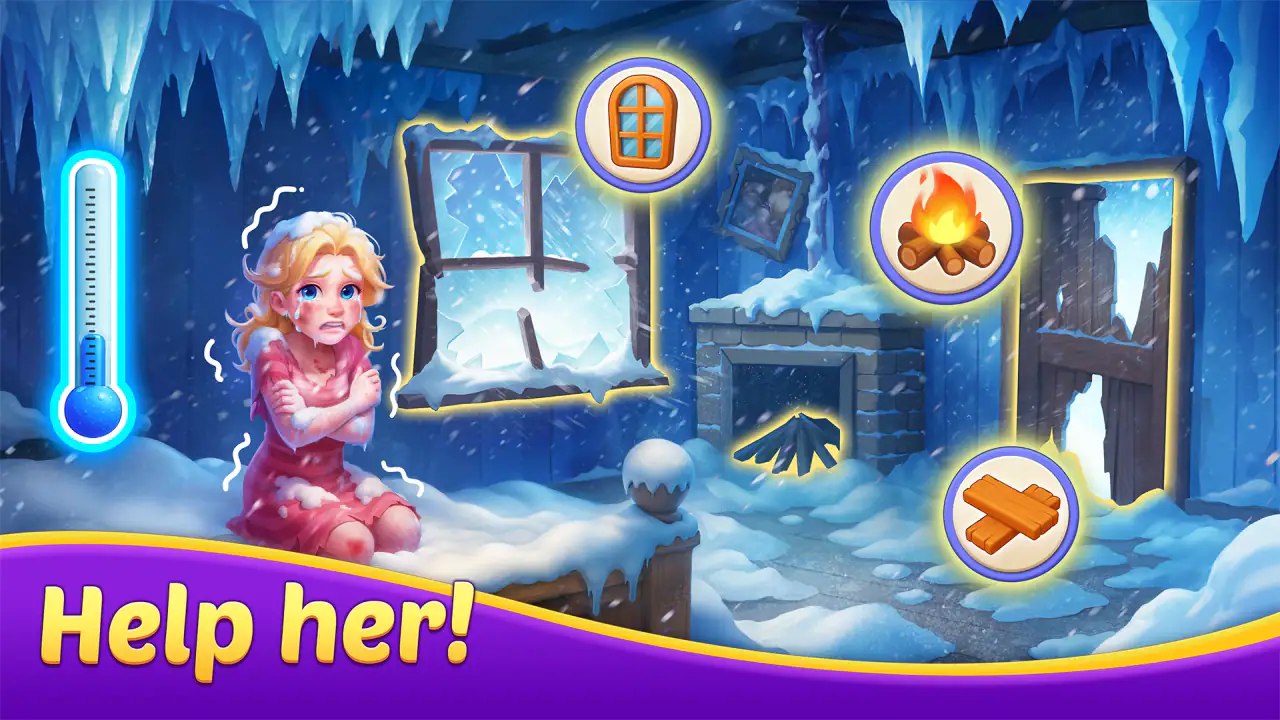
In an everyday situation, I might open it while waiting for a friend who is running late. I can play without needing to remember a complicated plot or rebuild a strategy from scratch. If the wait ends after one round, the session still feels complete. If I have more time, I can continue into another level and make more progress. That flexibility is one of the clearest reasons I would recommend it to casual players.
There is a trade-off, though. The short-session structure depends on the game presenting a steady enough flow of meaningful progress. When a level takes several attempts or progress begins to feel slower, the same five-minute visit can feel less rewarding. I do not mind an occasional difficult board, but players who expect every session to deliver a visible renovation may become impatient when the puzzle temporarily becomes the main obstacle.
I would also avoid playing it when I want a puzzle with a single correct solution or a large amount of planning. The matching format is about spotting useful combinations and managing the board in front of me, not solving a carefully constructed logic problem. For that kind of experience, a traditional logic title, word puzzle, or number game would be a better fit.
Designed to survive interruptions
One of the most useful qualities here is how naturally it accommodates interruptions. The individual activities are easy to understand when I return, so I am not punished for stepping away from the screen. I do not have to remember a complicated sequence of actions or reconstruct a long tactical plan. That makes it more practical than many story-heavy games for people whose playtime is constantly broken up.
This is especially helpful on a phone. I can begin a session with no expectation that I will finish a long chapter. If someone calls, a task appears, or I simply lose interest, I can stop without feeling that I have wasted a large investment. When I come back later, the mansion and its renovation goals provide enough context to remind me what I was doing.
That does not mean every interruption feels equally smooth. A puzzle is still a puzzle, and stopping in the middle of a board is less satisfying than finishing a round. My preferred habit is to play when I can spare enough time to complete one level, then close the app after collecting the result. This keeps the game feeling tidy rather than leaving me with an unfinished board hanging over the next visit.
The game runs on Android devices using version 6.0 or later, and the current version is 1.197.0. For someone deciding whether an older phone or tablet can handle it, the operating-system requirement is the practical detail to check first. I would also keep the game updated when possible, since casual titles with a long publishing history can change their balance and presentation over time.
Another useful approach is to separate “I have a few minutes” from “I want to make major progress.” A quick visit is still worthwhile even when I do not complete several renovation tasks. If I expect every launch to produce a dramatic transformation, the game can feel slower than it really is. If I treat it as a small recurring activity, its pacing makes more sense.
The pleasure of improvement and the limits of repetition
The renovation layer gives the game its personality, but it also reveals its repetitive side. Matching boards naturally repeat the same basic action, and the mansion’s improvement cycle follows a familiar pattern: complete a puzzle, earn progress, choose or apply an improvement, then continue. That loop is satisfying when I want routine. It is less appealing when I am looking for constant novelty.
I think the game works best for people who enjoy incremental change. Watching a space become more attractive over many small decisions can be relaxing, especially when the alternative is a more intense game that demands attention every second. The reward is not just the individual match; it is the accumulation of many modest changes.
However, the renovation theme cannot completely hide the repetition of the underlying puzzle. After a long session, I notice the structure more clearly. The visual setting remains pleasant, but the action itself can begin to feel like work. My solution is simple: I play in short visits and switch to another kind of game when I start making moves automatically. This title benefits from restraint more than from marathon sessions.
That is also where it differs from usual alternatives in the puzzle category. A pure match game may offer a cleaner focus on board skill, while a logic game may provide more mental depth. A decoration-focused game may offer more control over appearance but less moment-to-moment interaction. Matchington Mansion sits between those options. It uses matching as the engine and renovation as the reward, so it is more immediately active than a passive decorating experience but less strategically demanding than a serious puzzle title.
The combination is a strength for a mixed audience. Someone who would not play a bare matching game may stay interested because the mansion gives the levels context. Someone who likes decorating may appreciate having a small challenge before each improvement. The compromise is that neither side receives the deepest possible version of its favorite activity.
How I handle the free-to-play friction
The game is free, but it includes optional in-app purchases ranging from twenty-nine cents to $139.99 per item. That is important because the basic experience may be easy to begin, while the temptation to spend can become more noticeable as progress slows or a level becomes frustrating. I would approach it as a free casual game first and decide in advance whether I want to spend anything at all.
For a relaxed player, the safest routine is to enjoy the available attempts and accept that progress may sometimes be gradual. I would not buy something simply because I was annoyed by one difficult board. Waiting and returning later can change how the level feels, and the whole appeal of this kind of game is that it is not supposed to demand constant urgency.
Parents should also remember that an Everyone rating describes the content, not a personal spending plan. If a child uses the game, device-level purchase controls are sensible. The presence of optional items means the free starting point should not be confused with an entirely pressure-free experience.
I found that the renovation goals help reduce the sting of repetition, but they do not eliminate the underlying resource and progress considerations common to free-to-play puzzle games. Players who dislike any form of waiting, retrying, or purchase prompting may prefer a paid puzzle with a fixed structure. Players who are comfortable moving slowly can get more value from the free format by refusing to let a single level dictate their mood.
Who will enjoy it, and who should skip it
I would recommend it to someone who wants a friendly, low-commitment puzzle game with a visual sense of progress. It is particularly suitable for players who enjoy home makeovers, light narrative framing, and small tasks that can be completed independently. It also suits people who play on the move and need something that remains understandable after an interruption.
It is a weaker recommendation for anyone seeking competitive leaderboards, direct multiplayer interaction, demanding logic, or a large amount of control over every design detail. I would also hesitate to suggest it to a player who becomes frustrated by repeated attempts or who wants a game that feels radically different from one session to the next. The mansion theme is inviting, but it cannot turn a familiar matching loop into an endlessly fresh challenge.
For families, the broad age rating makes the presentation approachable, but the purchase structure still deserves attention. For older devices, the minimum operating-system requirement is the first compatibility check. For people with limited storage or data, I would make sure the phone has enough room and a reliable connection before committing to it, rather than assuming every device will behave identically.
Its audience size reflects how accessible the formula is: the game has passed 100 million installs, carries a 4.4 average from around 2.4 million ratings, and has roughly 104 thousand written reviews. I read those figures as evidence of broad appeal, not as proof that every player will enjoy the pacing. A popular casual loop can still be the wrong choice for someone who wants complexity or a completely uninterrupted experience.
My casual verdict after living with the loop
What stays with me is not a single brilliant puzzle mechanic but the ease of returning to the mansion. I can open it without preparing myself, understand the immediate goal, and leave after a compact session without losing the thread. That makes it a strong companion for spare moments, especially when I want a little progress and color rather than a serious test of concentration.
The game is at its best when I keep expectations modest. I do not treat it as a deep strategy title or demand constant surprises. Instead, I use it as a gentle routine: complete a board, improve a space, enjoy the visible result, and stop before the repetition becomes obvious. That approach makes the short-session design feel intentional rather than limited.
My honest recommendation is to try it if immediate clarity and interruption-friendly play matter more to you than novelty. The free entry point makes that decision easy, while the optional purchases mean I would set spending boundaries before playing regularly. If you enjoy the mansion’s gradual transformation, the loop can remain pleasantly inviting. If you need intricate puzzles or a game that rewards long, uninterrupted concentration, another option will serve you better.
For me, Matchington Mansion succeeds as a casual puzzle game because it understands the value of a small, complete visit. It gives me an obvious action, a visible reason to continue, and enough continuity to make tomorrow’s session feel connected to today’s. Its repetition and free-to-play friction are real limitations, but within its intended lane, it remains an easy game to pick up, pause, and recommend to a friend who wants uncomplicated entertainment.
FAQs for Matchington Mansion
What is the main objective of Matchington Mansion?
Matchington Mansion is a match-3 puzzle game where players renovate and decorate a mansion by solving levels. The main objective is to complete puzzles to earn stars, which are then used to unlock new decorations, furniture, and upgrades for the mansion, enhancing both its aesthetic appeal and functionality.
Does Matchington Mansion require an internet connection to play?
While Matchington Mansion can be played offline, certain features like in-game purchases, events, and social interactions may require an internet connection. Playing online also allows for cloud saving, which ensures your progress is backed up and can be accessed across different devices.
Are there any in-app purchases in Matchington Mansion?
Yes, Matchington Mansion offers in-app purchases. Players can buy coins and power-ups to help progress through challenging levels more easily. While these purchases can enhance gameplay, they are optional, and players can enjoy the game without spending money by relying on strategy and patience.
How does the game’s difficulty progress in Matchington Mansion?
The difficulty in Matchington Mansion increases as players advance through levels. Early levels are designed to be introductory, but as players progress, puzzles become more complex, requiring strategic planning and use of power-ups to solve. This gradual increase challenges players to refine their skills and strategies.
Can I play Matchington Mansion with friends?
Yes, Matchington Mansion allows you to connect with friends through social media platforms. By doing so, you can share lives, compete on leaderboards, and exchange gifts. This social aspect adds a layer of interaction and friendly competition, enhancing the overall gaming experience.
Pros
- Engaging puzzle gameplay with unique challenges.
- Beautifully designed mansion to decorate.
- Frequent updates and new levels added.
- Charming characters and engaging story.
- Offline play available for on-the-go fun.
Cons
- In-app purchases can become costly.
- Some levels might feel repetitive.
- Energy system limits extended play.
- Occasional ads can interrupt gameplay.
- Decorating can be slow without purchases.


